Why Bedtime Stories Help Kids Fall Asleep
The science behind the oldest sleep hack in human history
Every parent discovers it eventually. The child who was bouncing off walls five minutes ago is now heavy-eyed and still, curled against your shoulder, breathing slowly. All you did was start reading.
Bedtime stories have been putting children to sleep for thousands of years. And it turns out, a bedtime story isn't just a nice ritual — it's a surprisingly sophisticated sleep tool.
Falling asleep is a descent, not a switch
A child's brain can't go from alert to asleep instantly. It has to move through stages — alert wakefulness, relaxed wakefulness, drowsiness, then sleep. The problem at bedtime is that the brain is still running at daytime speed. It needs a bridge.
A story provides that bridge. When a child listens, attention narrows from scattered awareness to a single thread. The body follows — heart rate slows, breathing steadies, muscles relax. And the predictable rhythm of a story signals safety, which tells the brain it's okay to let go of alertness.
The voice does as much work as the words
A calm, familiar voice activates the parasympathetic nervous system — the body's "rest and digest" mode. The child's breathing gradually synchronizes with the slow, steady rhythm of the reader's voice. Their nervous system uses the parent's calm state as a template for its own.
This is why a story read in a warm, slow voice works better than the same story read quickly or played at full volume. The pacing and tone are doing as much sleep work as the story itself.
Why stories beat screens and songs
A screen — even a calm video — produces blue-white light that suppresses melatonin. But beyond light, video is reactive stimulation. A story without visuals does the opposite — it invites the brain to generate its own images, which is an inward-turning, calming activity.
Songs end too quickly. A lullaby is great for the final moments, but 2-4 minutes isn't enough for a fully alert child to make the full descent. A story gives the brain 10-20 minutes of sustained, gradually deepening calm.
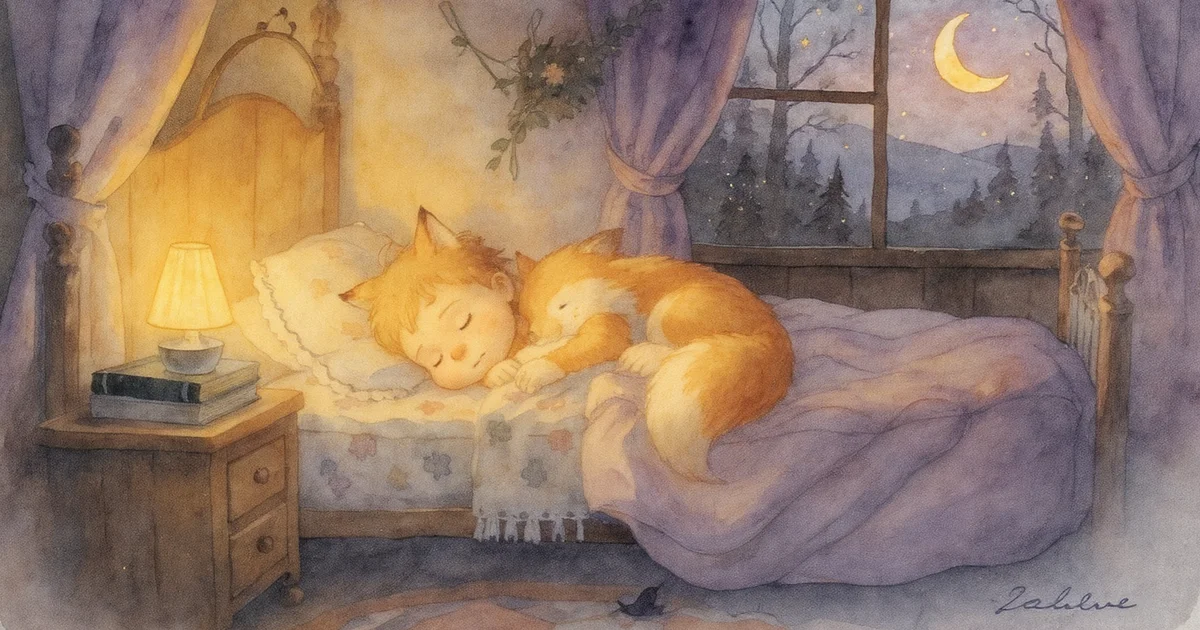
And stories create narrative absorption — a state where the real world fades into the background. The child isn't fighting sleep because they're not thinking about sleep. They're thinking about a little fox in a misty forest. While their conscious mind follows the fox, their body quietly does the work of falling asleep.
The three-phase trick parents use instinctively
Watch a skilled parent read at bedtime. They start with energy — voice animated, pace normal, matching the child's alert state. Then they slow down. The voice gets softer. Pauses get longer. By the final pages, they're barely whispering.
This maps perfectly to what sleep researchers call "arousal matching" — meeting the child where they are and guiding them down gradually. Start too slow and the child gets restless. Start at their level, then descend, and they follow without resistance.
What makes a good bedtime story
Not every story works at bedtime. The best ones share a few qualities: low stakes (nothing scary or unresolved), sensory richness (soft things, warm things, the sound of rain), repetition and rhythm ("The stars were still. The world was still. Everything was still."), and a gentle ending that resolves into stillness.
The bottom line
Bedtime stories narrow attention, lower arousal, synchronize breathing, create safety, and provide a gradual bridge from wakefulness to sleep.
No app or device can replace a parent reading in the room. But on nights when that's not possible — when you're exhausted, traveling, or need a break — a well-designed audio story following these same principles can do remarkable work. The voice, the pacing, the arc from engaging to whisper-quiet: these are the ingredients that matter.
Your child's brain already knows how to fall asleep. A good bedtime story just gives it permission.
Comments (0)